

All Obstacles During AZ-700 Exam Preparation with AZ-700 Real Test Questions
Fully Updated Free Actual Microsoft AZ-700 Exam Questions
NEW QUESTION # 203
You have an Azure subscription that contains multiple virtual machines in the West US Azure region.
You need to use Traffic Analytics.
Which two resources should you create? Each correct answer presents part of the solution. (Choose two.) NOTE: Each correct answer selection is worth one point.
- A. an Azure Sentinel workspace
- B. an Azure Monitor workbook
- C. a storage account
- D. a Log Analytics workspace
- E. an Azure Monitor data collection rule
Answer: C,D
Explanation:
Reference:
https://docs.microsoft.com/en-us/azure/network-watcher/traffic-analytics A storage acccount is used to store network security group flow logs.
A Log Analytics workspace is used by Traffic Analytics to store the aggregated and indexed data that is then used to generate the analytics.
https://docs.microsoft.com/en-us/azure/network-watcher/traffic-analytics#enable-flow-log-settings
NEW QUESTION # 204
You need to provide access to storage2. The solution must meet the PaaS networking requirements and the business requirements.
Which connectivity method should you use?
- A. a private endpoint
- B. Azure Front Door
- C. Azure Firewall
- D. a service endpoint
Answer: D
NEW QUESTION # 205
You have an Azure subscription that contains the resources shown in the following table.
You establish BGP peering between NVA1 and Hub1.
You need to implement transit connectivity between VNet1 and VNet3 via Hub1 by using BGP peering. The solution must minimize costs.
What should you do? To answer, select the appropriate options in the answer area.
NOTE: Each correct selection is worth one point.
Answer:
Explanation:
Explanation
NEW QUESTION # 206
You plan to implement an Azure Virtual WAN named VWAN1 that will contain a hub named Hub1.
VWAN1 will include the virtual networks shown in the following table.
You need to ensure that hosts connected to VNet1 can communicate with hosts connected to VNet3.
How should you configure the routing tables for VWAN1? To answer, select the appropriate options in the answer area.
NOTE: Each correct selection is worth one point.
Answer:
Explanation:
Explanation:
NEW QUESTION # 207
Drag and Drop Question
You have a DNS domain named contoso.com that is hosted by a third-party domain name registrar.
You have an Azure subscription.
You need to ensure that all DNS queries for the contoso.com domain are resolved by using Azure DNS.
What should you create in the registrar, and what should you create in Azure? To answer, drag the appropriate options to the correct targets. Each option may be used once, more than once, or not at all. You may need to drag the split bar between panes or scroll to view content.
NOTE: Each correct selection is worth one point.
Answer:
Explanation:
NEW QUESTION # 208
You have an Azure subscription that contains the resources shown in the following table.
You need to associate Gateway 1 with Subnet1. The solution must minimize downtime on VM1.
Which three actions should you perform in sequence? To answer, move the appropriate actions from the list of actions to the answer area and arrange them in the correct order.
Answer:
Explanation:
Explanation:
NEW QUESTION # 209
Hotspot Question
You have the Azure environment shown in the exhibit.
You have virtual network peering between Vnet1 and Vnet2. You have virtual network peering between Vnet4 and Vnet5. The virtual network peering is configured as shown in the following table.
For each of the following statements, select Yes if the statement is true. Otherwise, select No.
NOTE: Each correct selection is worth one point.
Answer:
Explanation:
Explanation:
Box 1: Yes
Virtual network peering seamlessly connects two Azure virtual networks, merging the two virtual networks into one for connectivity purposes. Gateway transit is a peering property that lets one virtual network use the VPN gateway in the peered virtual network for cross-premises or VNet-to- VNet connectivity.
The following diagram shows how gateway transit works with virtual network peering.
In the diagram, gateway transit allows the peered virtual networks to use the Azure VPN gateway in Hub-RM. Connectivity available on the VPN gateway, including S2S, P2S, and VNet-to-VNet connections, applies to all three virtual networks.
In hub-and-spoke network architecture, gateway transit allows spoke virtual networks to share the VPN gateway in the hub, instead of deploying VPN gateways in every spoke virtual network.
Box 2: Yes
VM2 uses the remote gateway GW1 to reach VM4.
Box 3: Yes
Traffic to remove virtual network: Block' setting in Vnet5 does not block communication between VM5 and GW4, while it blocks communication between VM5 and VM4.
Reference:
https://docs.microsoft.com/en-us/azure/vpn-gateway/vpn-gateway-peering-gateway-transit
https://docs.microsoft.com/en-us/azure/virtual-network/virtual-network-troubleshoot-peering- issues
NEW QUESTION # 210
You have an Azure subscription that contains a user named Admin1 and a resource group named RG1.
RG1 contains an Azure Network Watcher instance named NW1.
You need to ensure that Admin1 can place a lock on NW1. The solution must use the principle of least privilege.
Which role should you assign to Admin1?
- A. Resource Policy Contributor
- B. Monitoring Contributor
- C. User Access Administrator
- D. Network Contributor
Answer: C
Explanation:
To create or delete management locks, you need access to Microsoft.Authorization/* or Microsoft.Authorization/locks/* actions. Only the Owner and the User Access Administrator built- in roles can create and delete management locks.
https://learn.microsoft.com/en-us/azure/azure-resource-manager/management/lock- resources?tabs=json#who-can-create-or-delete-locks
NEW QUESTION # 211
You have an on-premises server named Server1 that runs Windows Server.
You have an Azure subscription that contains a virtual network named VNet1.
You plan to connect Server1 to VNet1 by using Azure Network Adapter.
You need to minimize how long it takes to deploy the adapter to Server1.
What should you create first?
- A. a route server
- B. a private endpoint
- C. an Azure VPN gateway
- D. an Azure Bastion host
Answer: C
Explanation:
Considering that in the Microsoft process (here attached) for Azure Network adapter a VPN Gateway is included.
https://learn.microsoft.com/en-us/windows-server/manage/windows-admin-center/azure/use- azure-network-adapter
NEW QUESTION # 212
You have an on-premises datacenter and an Azure subscription.
You plan to implement ExpressRoute FastPath.
You need to create an ExpressRoute gateway. The solution must minimize downtime if a single Azure datacenter fails.
Which SKU should you use?
- A. ErGw3AZ
- B. ErGw1AZ
- C. ErGw2AZ
- D. Ultra performance
- E. High performance
Answer: A
Explanation:
ErGw3Az and Ultra Performance SKU supports FastPath.
ErGw3Az is Zone-redundant, but not Ultra Performance SKU.
https://learn.microsoft.com/en-us/azure/expressroute/expressroute-about-virtual-network- gateways#zrgw
https://learn.microsoft.com/en-us/azure/expressroute/about-fastpath#gateways
NEW QUESTION # 213
You have an Azure subscription that contains the resources shown in the following table.
You need to associate Gateway 1 with Subnet1. The solution must minimize downtime on VM1.
Which three actions should you perform in sequence? To answer, move the appropriate actions from the list of actions to the answer area and arrange them in the correct order.
Answer:
Explanation:
Explanation
NEW QUESTION # 214
You have an Azure subscription that contains the virtual machines shown in the following table.
Subnet1 and Subnet2 are associated to a network security group (NSG) named NSG1 that has the following outbound rule:
* Priority: 100
* Port: Any
* Protocol: Any
* Source: Any
* Destination: Storage
* Action: Deny
You create a private endpoint that has the following settings:
* Name: Private1
* Resource type: Microsoft.Storage/storageAccounts
* Resource: storage1
* Target sub-resource: blob
* Virtual network: Vnet1
* Subnet: Subnet1
For each of the following statements, select Yes of the statement is true. Otherwise, select No.
NOTE: Each correct selection is worth one point.
Answer:
Explanation:
Explanation
Graphical user interface, text, application Description automatically generated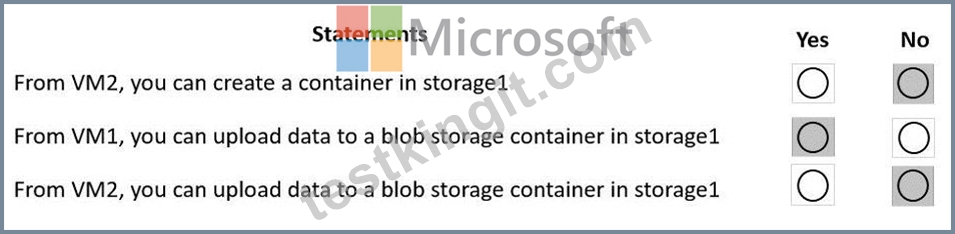
Reference:
https://docs.microsoft.com/en-us/azure/private-link/disable-private-endpoint-network-policy
NEW QUESTION # 215
You have an Azure subscription that contains the resources shown in the following table.
You establish BGP peering between NVA1 and Hub1.
You need to implement transit connectivity between VNet1 and VNet3 via Hub1 by using BGP peering. The solution must minimize costs.
What should you do? To answer, select the appropriate options in the answer area.
NOTE: Each correct selection is worth one point.
Answer:
Explanation:
Explanation:
NEW QUESTION # 216
You have an Azure subscription that contains a virtual machine named VM1. VM1 contains a NIC named NIC1 and a public IP address named PIP1.PIP1 is assigned to NIC1.
You plan to deploy four Network Virtual Appliances (NVAs).
You need to ensure that all the inbound traffic from the internet to PIP1 is inspected by the NVAs. The solution must ensure that the NVA deployment is highly available.
Which three actions should you perform in sequence? To answer, move the appropriate actions from the list of actions to the answer area and arrange them in the correct order.
Answer:
Explanation:
Explanation:
NEW QUESTION # 217
You have the network security groups (NSGs) shown in the following table.
In NSG1, you create inbound rules as shown in the following table.
You have the Azure virtual machines shown in the following table.
NSG2 has only the default rules configured.
For each of the following statements, select Yes if the statement is true. Otherwise, select No.
NOTE: Each correct selection is worth one point.
Answer:
Explanation:
NEW QUESTION # 218
Your company has an Azure virtual network named Vnet1 that uses an IP address space of 192.168.0.0/20.
Vnet1 contains a subnet named Subnet1 that uses an IP address space of 192.168.0.0/24.
You create an IPv6 address range to Vnet1 by using a CIDR suffix of /48.
You need to enable the virtual machines on Subnet1 to communicate with each other by using IPv6 addresses assigned by the company. The solution must minimize the number of additional IPv4 addresses.
What should you do? To answer, select the appropriate options in the answer area.
NOTE: Each correct selection is worth one point.
Answer:
Explanation:
Explanation
Graphical user interface, text, application Description automatically generated
Reference:
https://docs.microsoft.com/en-us/azure/virtual-network/ipv6-overview
https://docs.microsoft.com/en-us/azure/virtual-network/ipv6-add-to-existing-vnet-powershell
NEW QUESTION # 219
......
Microsoft AZ-700 Certification Exam is intended for Azure networking professionals who have a good understanding of Azure networking concepts and services and have experience in designing and implementing Azure networking solutions. Candidates for AZ-700 exam should have a minimum of two years of experience in designing and implementing Azure networking solutions and should have a good understanding of network security, routing, and load balancing. Successful candidates will be able to design and implement Azure networking solutions that meet the requirements of their organization and ensure the security, scalability, and availability of their Azure resources. The Microsoft AZ-700 Certification Exam is a great way for Azure networking professionals to validate their skills and knowledge and advance their career in the Azure ecosystem.
Validate your AZ-700 Exam Preparation with AZ-700 Practice Test: https://exampasspdf.testkingit.com/Microsoft/latest-AZ-700-exam-dumps.html