

Get Microsoft DP-600 Dumps Questions [2026] To Gain Brilliant Result
DP-600 dumps - TestKingsIT - 100% Passing Guarantee
NEW QUESTION # 43
You have a Fabric workspace named Workspace1.
Workspace1 contains multiple semantic models, including a model named Model1. Model1 is updated by using an XMLA endpoint.
You need to increase the speed of the write operations of the XMLA endpoint.
What should you do?
- A. Delete any unused columns from Model1.
- B. Delete any unused semantic models from Workspace1.
- C. Select Large semantic model storage format for Workspace1.
- D. Configure Model1 to use the Direct Lake storage format.
Answer: C
Explanation:
When using XMLA endpoints to manage and update semantic models in Microsoft Fabric, the performance of write operations (such as processing, structural changes, or metadata deployments from Tabular Editor) is directly influenced by the storage format and how the model is persisted.
Why Option A is Correct
* By default, Fabric semantic models use the Small semantic model storage format.
* To improve write operations performance through XMLA, you must change the workspace setting to use the Large semantic model storage format.
* The large format uses more efficient storage techniques, supports partitioning, and handles larger models with optimized write capabilities.
* This setting is applied at the workspace level and impacts all semantic models within that workspace, including Model1.
This is explicitly documented in Microsoft's guidance: Large semantic model storage format is required when using XMLA write operations for large or frequently updated models.
Why the Other Options Are Incorrect
B). Configure Model1 to use the Direct Lake storage format.
* Direct Lake mode is designed for query performance (reading data directly from OneLake in delta format without import/duplication).
* It improves query latency and freshness but does not improve XMLA write operations, which deal with model metadata and structural updates.
C). Delete any unused semantic models from Workspace1.
* Deleting unused semantic models helps manage capacity and storage but does not increase the speed of XMLA endpoint write operations.
* Workspace storage overhead does not directly impact the write throughput of XMLA operations.
D). Delete any unused columns from Model1.
* Removing unused columns reduces the memory footprint and can improve query performance.
* However, it does not directly improve the speed of XMLA write operations. The bottleneck in XMLA writes is tied to the storage format, not the model size alone.
Summary
To increase the speed of XMLA write operations on semantic models, you must enable the Large semantic model storage format at the workspace level. This setting ensures better handling of writes and metadata operations via the XMLA endpoint.
References
* Large models in Power BI and Microsoft Fabric
* Use the XMLA endpoint in Microsoft Fabric
* Manage capacities in Microsoft Fabric
NEW QUESTION # 44
You need to create a DAX measure to calculate the average overall satisfaction score.
How should you complete the DAX code? To answer, select the appropriate options in the answer area.
NOTE: Each correct selection is worth one point.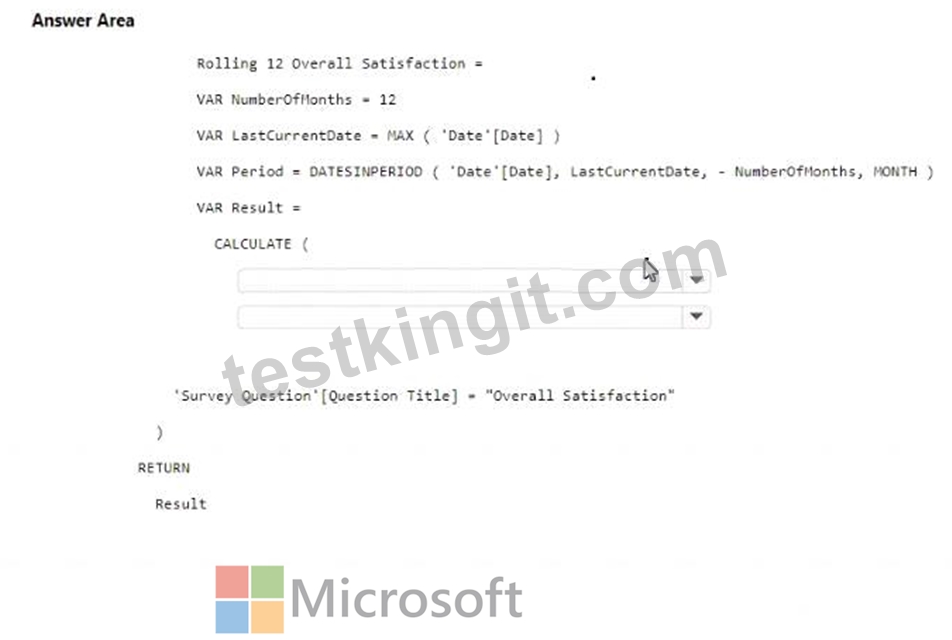
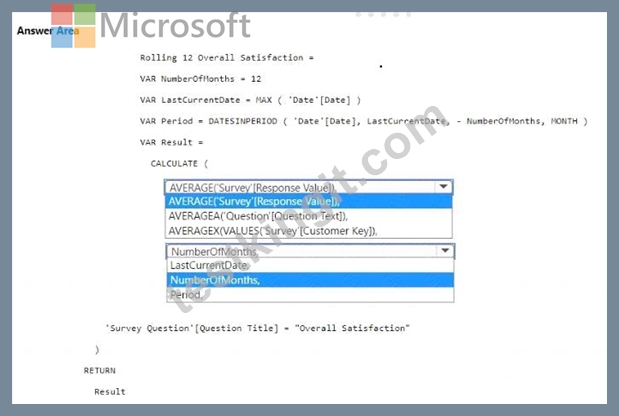
Answer:
Explanation: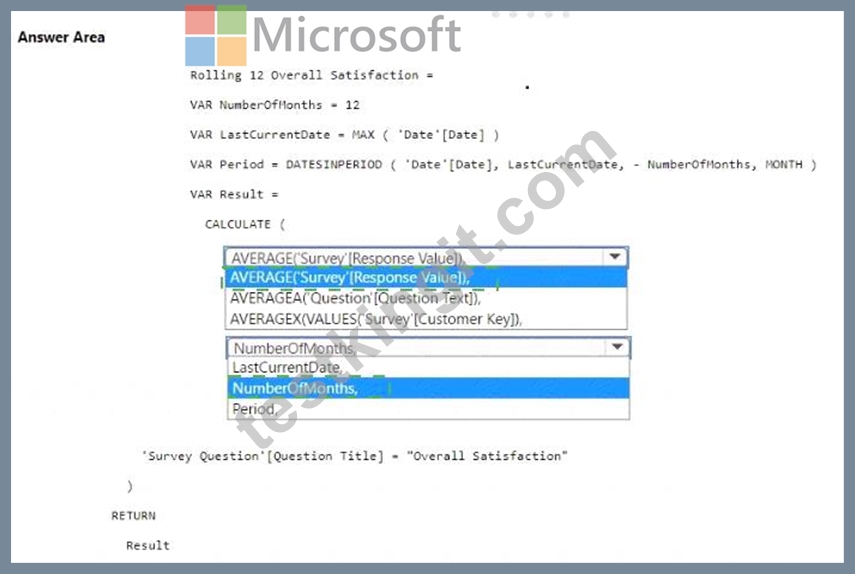
Explanation:
* The measure should use the AVERAGE function to calculate the average value.
* It should reference the Response Value column from the 'Survey' table.
* The 'Number of months' should be used to define the period for the average calculation.
To calculate the average overall satisfaction score using DAX, you would need to use the AVERAGE function on the response values related to satisfaction questions. The DATESINPERIOD function will help in calculating the rolling average over the last 12 months.
NEW QUESTION # 45
You have a Fabric tenant that contains a warehouse named Warehouse1. Warehouse1 contains three schemas named schemaA, schemaB. and schemaC You need to ensure that a user named User1 can truncate tables in schemaA only.
How should you complete the T-SQL statement? To answer, select the appropriate options in the answer area.
NOTE: Each correct selection is worth one point.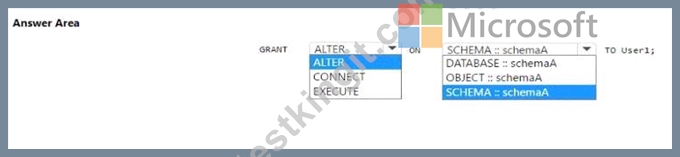
Answer:
Explanation: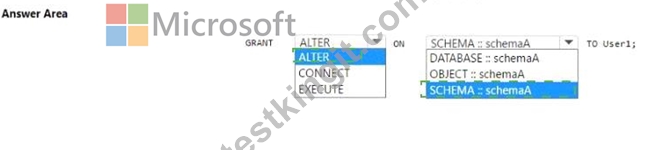
Explanation:
* GRANT ALTER ON SCHEMA::schemaA TO User1;
The ALTER permission allows a user to modify the schema of an object, and granting ALTER on a schema will allow the user to perform operations like TRUNCATE TABLE on any object within that schema. It is the correct permission to grant to User1 for truncating tables in schemaA.
References =
* GRANT Schema Permissions
* Permissions That Can Be Granted on a Schema
NEW QUESTION # 46
You have a Fabric tenant that contains a warehouse.
Several times a day. the performance of all warehouse queries degrades. You suspect that Fabric is throttling the compute used by the warehouse.
What should you use to identify whether throttling is occurring?
- A. dynamic management views (DMVs)
- B. the Monitoring hub
- C. the Microsoft Fabric Capacity Metrics app
- D. the Capacity settings
Answer: B
Explanation:
To identify whether throttling is occurring, you should use the Monitoring hub (B). This provides a centralized place where you can monitor and manage the health, performance, and reliability of your data estate, and see if the compute resources are being throttled. References = The use of the Monitoring hub for performance management and troubleshooting is detailed in the Azure Synapse Analytics documentation.
NEW QUESTION # 47
You have a Fabric tenant that contains a workspace named Workspace1 and a user named User1. User1 is assigned the Contributor role for Workspace1.
You plan to configure Workspace1 to use an Azure DevOps repository for version control.
You need to ensure that User1 can commit items to the repository.
Which two settings should you enable for User1? Each correct answer presents part of the solution.
NOTE: Each correct selection is worth one point.
- A. Users can create Fabric items
- B. Users can create and use Data workflows
- C. Users can sync workspace items with GitHub repositories
- D. Users can synchronize workspace items with their Git repositories
Answer: A,D
NEW QUESTION # 48
You have a Fabric tenant that contains a workspace named Workspace^ Workspacel is assigned to a Fabric capacity.
You need to recommend a solution to provide users with the ability to create and publish custom Direct Lake semantic models by using external tools. The solution must follow the principle of least privilege.
Which three actions in the Fabric Admin portal should you include in the recommendation? Each correct answer presents part of the solution.
NOTE: Each correct answer is worth one point.
- A. From the Capacity settings, set XMLA Endpoint to Read Write
- B. From the Tenant settings, set Allow XMLA Endpoints and Analyze in Excel with on-premises datasets to Enabled
- C. From the Tenant settings, set Allow Azure Active Directory guest users to access Microsoft Fabric to Enabled
- D. From the Tenant settings, set Users can create Fabric items to Enabled
- E. From the Tenant settings, enable Publish to Web
- F. From the Tenant settings, select Users can edit data models in the Power Bl service.
Answer: A,B,F
Explanation:
For users to create and publish custom Direct Lake semantic models using external tools, following the principle of least privilege, the actions to be included are enabling XMLA Endpoints (A), editing data models in Power BI service (C), and setting XMLA Endpoint to Read-Write in the capacity settings (D). Reference = More information can be found in the Admin portal of the Power BI service documentation, detailing tenant and capacity settings.
NEW QUESTION # 49
You have a Fabric tenant that contains a workspace named Workspace1. Workspace1 uses Pro license mode and contains a semantic model named Model1. You need to ensure that Modell supports XMLA connections.
Which setting should you modify?
- A. Users can edit data models in the Power B1 service
- B. Enforce strict access control for all data connection types
- C. Enable Cache for Shortcuts
- D. License mode
Answer: D
Explanation:
XMLA endpoint connectivity (read/write) requires the workspace to be in Fabric (Premium) capacity.
A Pro workspace does not support XMLA connections.
Therefore, to enable XMLA for Model1, you must change the License mode from Pro to Premium/Fabric.
Correct answer: B
Reference: XMLA endpoints in Power BI/Fabric
NEW QUESTION # 50
You have a Fabric warehouse that contains a table named Sales.Products. Sales.Products contains the following columns.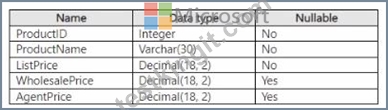
You need to write a T-SQL query that will return the following columns.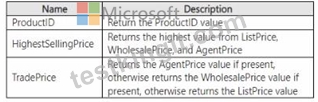
How should you complete the code? To answer, select the appropriate options in the answer area.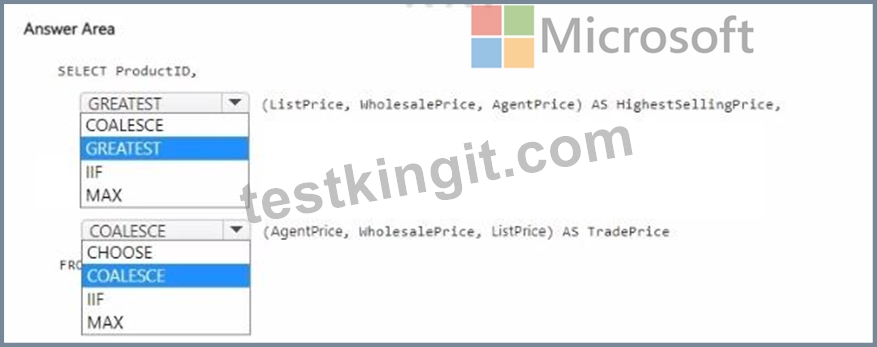
Answer:
Explanation: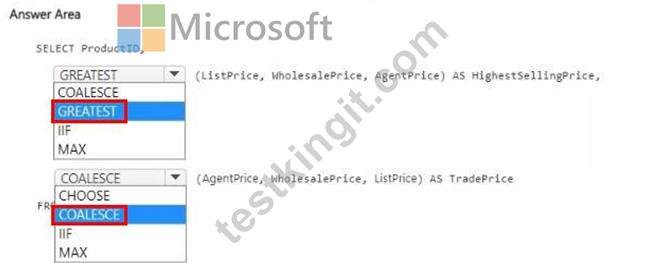
NEW QUESTION # 51
You have a Fabric tenant that contains a semantic model. The model contains data about retail stores.
You need to write a DAX query that will be executed by using the XMLA endpoint. The query must return the total amount of sales from the same period last year.
How should you complete the DAX expression? To answer, select the appropriate options in the answer area.
NOTE: Each correct selection is worth one point.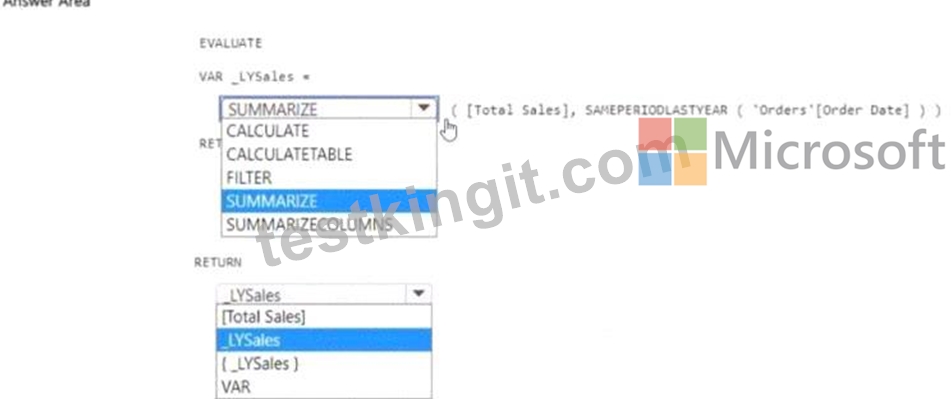
Answer:
Explanation: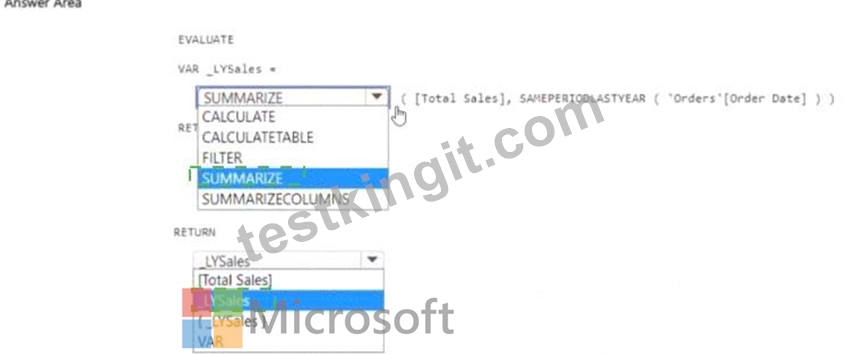
Explanation: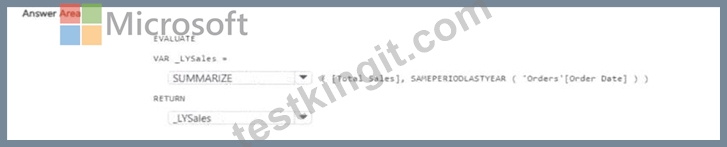
NEW QUESTION # 52
You have the source data model shown in the following exhibit.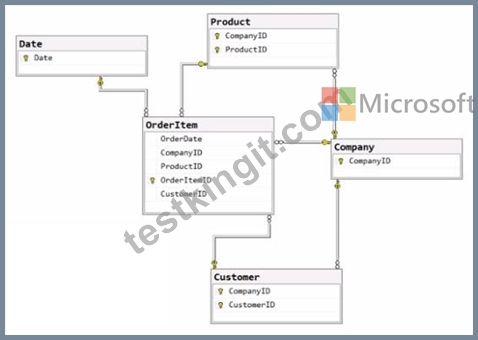
The primary keys of the tables are indicated by a key symbol beside the columns involved in each key.
You need to create a dimensional data model that will enable the analysis of order items by date, product, and customer.
What should you include in the solution? To answer, select the appropriate options in the answer area.
NOTE: Each correct selection is worth one point.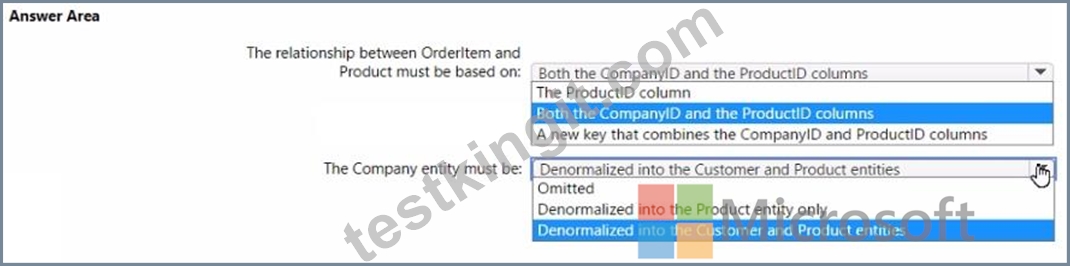
Answer:
Explanation: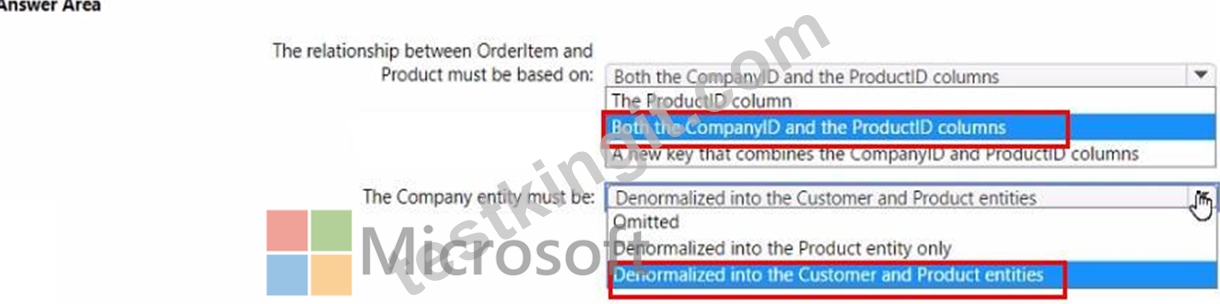
NEW QUESTION # 53
You have a Microsoft Power BI semantic model.
You need to identify any surrogate key columns in the model that have the Summarize By property set to a value other than to None. The solution must minimize effort.
What should you use?
- A. Model view in Microsoft Power BI Desktop
- B. Model explorer in Microsoft Power BI Desktop
- C. Best Practice Analyzer in Tabular Editor
- D. DAX Formatter in DAX Studio
Answer: C
Explanation:
Best Practice Analyzer should be able to identify these with some rules.
NEW QUESTION # 54
You need to recommend a solution to prepare the tenant for the PoC.
Which two actions should you recommend performing from the Fabric Admin portal? Each correct answer presents part of the solution.
NOTE: Each correct answer is worth one point.
- A. Enable the Users can try Microsoft Fabric paid features option for specific security groups.
- B. Enable the Allow Azure Active Directory guest users to access Microsoft Fabric option for specific security groups.
- C. Enable the Users can create Fabric items option and exclude specific security groups.
- D. Enable the Users can create Fabric items option for specific security groups.
- E. Enable the Users can try Microsoft Fabric paid features option for the entire organization.
Answer: A,D
Explanation:
The PoC is planned to be completed using a Fabric trial capacity, which implies that users involved in the PoC should be able to try paid features. However, this should be limited to specific security groups involved in the PoC to prevent the entire organization from accessing these features before the trial is proven successful (A).
The ability for users to create Fabric items should also be enabled for specific security groups to ensure that only the relevant team members participating in the PoC can create items in the Fabric environment (E).
NEW QUESTION # 55
Note: This question is part of a series of questions that present the same scenario. Each question in the series contains a unique solution that might meet the stated goals. Some question sets might have more than one correct solution, while others might not have a correct solution.
After you answer a question in this section, you will NOT be able to return to it. As a result, these questions will not appear in the review screen.
You have a Fabric tenant that contains a semantic model named Model1.
You discover that the following query performs slowly against Model1.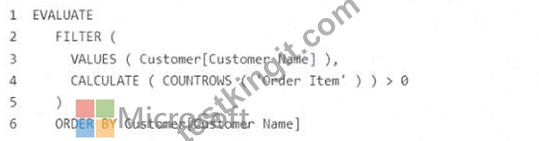
You need to reduce the execution time of the query.
Solution: You replace line 4 by using the following code:
Does this meet the goal?
- A. No
- B. Yes
Answer: A
NEW QUESTION # 56
You have a Fabric tenant that contains two workspaces named Woritspace1 and Workspace2. Workspace1 contains a lakehouse named Lakehouse1. Workspace2 contains a lakehouse named Lakehouse2. Lakehouse!
contains a table named dbo.Sales. Lakehouse2 contains a table named dbo.Customers.
You need to ensure that you can write queries that reference both dbo.Sales and dbo.Customers in the same SQL query without making additional copies of the tables.
What should you use?
- A. a managed table
- B. a view
- C. a shortcut
- D. a dataflow
Answer: B
NEW QUESTION # 57
You have a Fabric workspace that contains a DirectQuery semantic model. The model queries a data source that has 500 million rows.
You have a Microsoft Power Bl report named Report1 that uses the model. Report! contains visuals on multiple pages.
You need to reduce the query execution time for the visuals on all the pages.
What are two features that you can use? Each correct answer presents a complete solution.
NOTE: Each correct answer is worth one point.
- A. OneLake integration
- B. automatic aggregation
- C. user-defined aggregations
- D. query caching
Answer: A,D
Explanation:
User-defined aggregations (A) and query caching (C) are two features that can help reduce query execution time. User-defined aggregations allow precalculation of large datasets, and query caching stores the results of queries temporarily to speed up future queries. Reference = Microsoft Power BI documentation on performance optimization offers in-depth knowledge on these features.
NEW QUESTION # 58
You have a Fabric tenant that contains a semantic model named model1. The two largest columns in model1 are shown in the following table.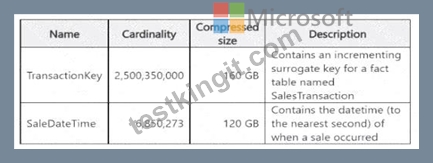
You need to optimize model 1. The solution must meet the following requirements:
* Reduce the model size.
* Increase refresh performance when using Import mode.
* Ensure that the datetime value for each sales transaction is available in the model.
What should you do on each column? To answer, select the appropriate options in the answer area.
NOTE: Each correct selection is worth one point.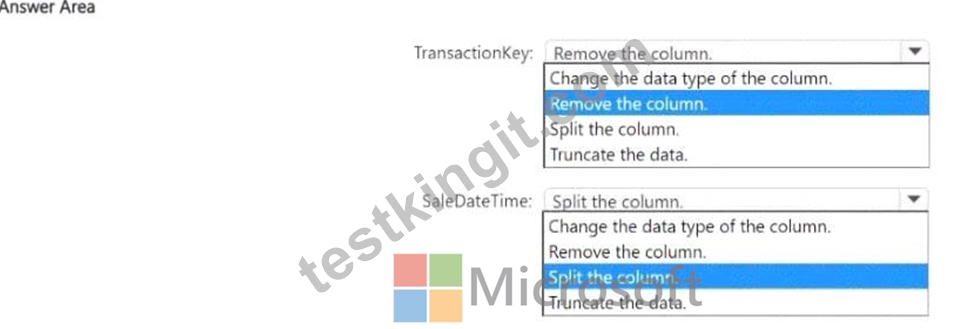
Answer:
Explanation: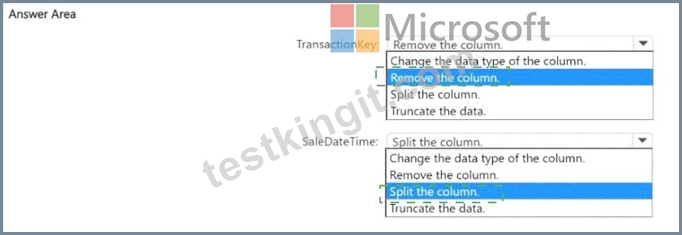
Explanation:
NEW QUESTION # 59
Your company has a finance department.
You have a Fabric tenant, an Azure Storage account named storagel, and a Microsoft Entra group named Groupl. Groupl contains the users in the finance department.
You need to create a new workspace named Workspacel in the tenant. The solution must meet the following requirements:
* Ensure that the finance department users can create and edit items in Workspace"!.
* Ensure that Workspacel can securely access storagel to read and write data.
* Ensure that you are the only admin of Workspacel.
* Minimize administrative effort.
You create Workspacel.
Which two actions should you perform next? Each correct answer presents part of the solution. NOTE: Each correct selection is worth one point.
- A. Assign the Contributor role to Groupl.
- B. Create a workspace identity.
- C. Assign the Admin role to yourself.
- D. Assign the Contributor role to each finance department user.
Answer: A,B
Explanation:
Finance department users can create and edit items in Workspace1 #
The correct role is Contributor.
To minimize effort, assign this role to the Microsoft Entra group (Group1) instead of assigning it to each user individually.
So answer A is correct, not B.
Workspace1 can securely access storagel (Azure Storage) to read and write data # To connect a Fabric workspace to external resources securely, you use a Workspace identity (a managed identity for the workspace).
This allows Fabric items to authenticate to Azure Storage without embedding credentials.
So answer D is correct.
You are the only admin of Workspace1 #
By default, the workspace creator (you) is the admin. You do not need to explicitly reassign the admin role to yourself (so C is unnecessary).
Minimize administrative effort #
Assigning Contributor role to the group (A) is minimal effort compared to assigning it individually to each user (B).
Final Answer:
A). Assign the Contributor role to Group1
D). Create a workspace identity
References:
Workspace roles in Microsoft Fabric
Workspace identity for secure data access
Topic 2, Litware. Inc. Case Study
Overview
Litware. Inc. is a manufacturing company that has offices throughout North America. The analytics team at Litware contains data engineers, analytics engineers, data analysts, and data scientists.
Existing Environment
litware has been using a Microsoft Power Bl tenant for three years. Litware has NOT enabled any Fabric capacities and features.
Fabric Environment
Litware has data that must be analyzed as shown in the following table.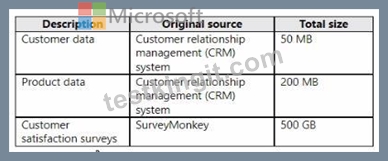
The Product data contains a single table and the following columns.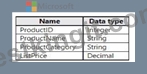
The customer satisfaction data contains the following tables:
* Survey
* Question
* Response
For each survey submitted, the following occurs:
* One row is added to the Survey table.
* One row is added to the Response table for each question in the survey.
The Question table contains the text of each survey question. The third question in each survey response is an overall satisfaction score. Customers can submit a survey after each purchase.
User Problems
The analytics team has large volumes of data, some of which is semi-structured. The team wants to use Fabric to create a new data store.
Product data is often classified into three pricing groups: high, medium, and low. This logic is implemented in several databases and semantic models, but the logic does NOT always match across implementations.
Planned Changes
Litware plans to enable Fabric features in the existing tenant. The analytics team will create a new data store as a proof of concept (PoC). The remaining Litware users will only get access to the Fabric features once the PoC is complete. The PoC will be completed by using a Fabric trial capacity.
The following three workspaces will be created:
* AnalyticsPOC: Will contain the data store, semantic models, reports, pipelines, dataflows, and notebooks used to populate the data store
* DataEngPOC: Will contain all the pipelines, dataflows, and notebooks used to populate Onelake
* DataSciPOC: Will contain all the notebooks and reports created by the data scientists The following will be created in the AnalyticsPOC workspace:
* A data store (type to be decided)
* A custom semantic model
* A default semantic model
* Interactive reports
The data engineers will create data pipelines to load data to OneLake either hourly or daily depending on the data source. The analytics engineers will create processes to ingest transform, and load the data to the data store in the AnalyticsPOC workspace daily. Whenever possible, the data engineers will use low-code tools for data ingestion. The choice of which data cleansing and transformation tools to use will be at the data engineers' discretion.
All the semantic models and reports in the Analytics POC workspace will use the data store as the sole data source.
Technical Requirements
The data store must support the following:
* Read access by using T-SQL or Python
* Semi-structured and unstructured data
* Row-level security (RLS) for users executing T-SQL queries
Files loaded by the data engineers to OneLake will be stored in the Parquet format and will meet Delta Lake specifications.
Data will be loaded without transformation in one area of the AnalyticsPOC data store. The data will then be cleansed, merged, and transformed into a dimensional model.
The data load process must ensure that the raw and cleansed data is updated completely before populating the dimensional model.
The dimensional model must contain a date dimension. There is no existing data source for the date dimension. The Litware fiscal year matches the calendar year. The date dimension must always contain dates from 2010 through the end of the current year.
The product pricing group logic must be maintained by the analytics engineers in a single location. The pricing group data must be made available in the data store for T-SQL queries and in the default semantic model. The following logic must be used:
* List prices that are less than or equal to 50 are in the low pricing group.
* List prices that are greater than 50 and less than or equal to 1,000 are in the medium pricing group.
* List pnces that are greater than 1,000 are in the high pricing group.
Security Requirements
Only Fabric administrators and the analytics team must be able to see the Fabric items created as part of the PoC. Litware identifies the following security requirements for the Fabric items in the AnalyticsPOC workspace:
* Fabric administrators will be the workspace administrators.
* The data engineers must be able to read from and write to the data store. No access must be granted to datasets or reports.
* The analytics engineers must be able to read from, write to, and create schemas in the data store. They also must be able to create and share semantic models with the data analysts and view and modify all reports in the workspace.
* The data scientists must be able to read from the data store, but not write to it. They will access the data by using a Spark notebook.
* The data analysts must have read access to only the dimensional model objects in the data store. They also must have access to create Power Bl reports by using the semantic models created by the analytics engineers.
* The date dimension must be available to all users of the data store.
* The principle of least privilege must be followed.
Both the default and custom semantic models must include only tables or views from the dimensional model in the data store. Litware already has the following Microsoft Entra security groups:
* FabricAdmins: Fabric administrators
* AnalyticsTeam: All the members of the analytics team
* DataAnalysts: The data analysts on the analytics team
* DataScientists: The data scientists on the analytics team
* Data Engineers: The data engineers on the analytics team
* Analytics Engineers: The analytics engineers on the analytics team
Report Requirements
The data analysis must create a customer satisfaction report that meets the following requirements:
* Enables a user to select a product to filter customer survey responses to only those who have purchased that product
* Displays the average overall satisfaction score of all the surveys submitted during the last 12 months up to a selected date
* Shows data as soon as the data is updated in the data store
* Ensures that the report and the semantic model only contain data from the current and previous year
* Ensures that the report respects any table-level security specified in the source data store
* Minimizes the execution time of report queries
NEW QUESTION # 60
You have a Fabric tenant that contains a workspace named Workspace1. Workspace1 contains a lakehouse named I.H1 and a warehouse named DW1. I.H1 contains a table named signindata that is in the dho schema.
You need to create a stored procedure in DW1 that deduplicates the data in the signindata table.
How should you complete the T-SQL statement? To answer, select the appropriate options in the answer area.
NOTE: Fach correct selection is worth one point.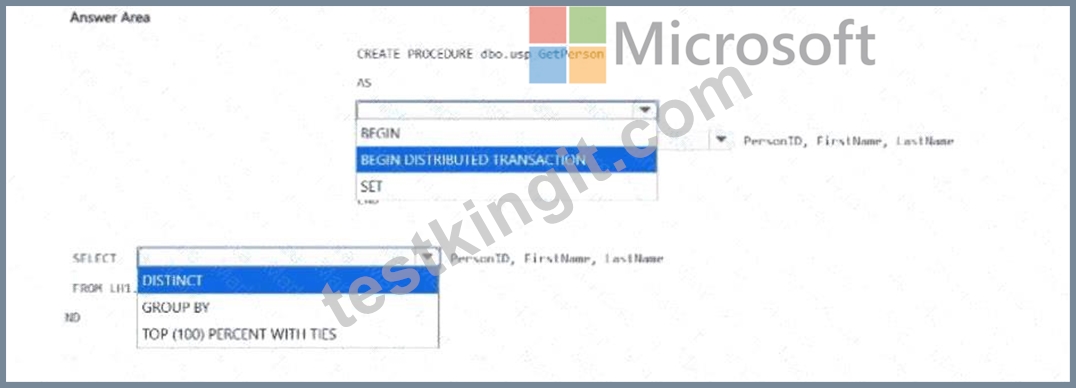
Answer:
Explanation: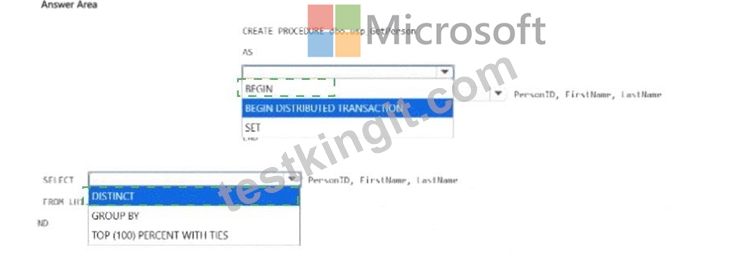
Explanation: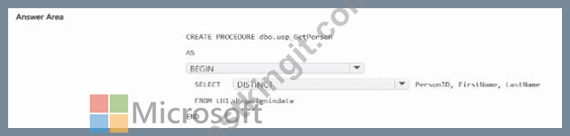
Scenario Recap
Fabric tenant # Workspace1
Contains:
Lakehouse LH1 (with table signindata in schema dho)
Warehouse DW1
Task: Create a stored procedure in DW1 that deduplicates rows in signindata.
Step 1: Stored procedure structure
In T-SQL, stored procedures begin with:
AS
BEGIN
-- logic
END
So the correct option for the first blank is BEGIN.
BEGIN DISTRIBUTED TRANSACTION is not needed because we are not spanning multiple servers or needing distributed transactions.
SET is not the right way to start the logic block.
Step 2: Deduplication logic
To remove duplicates from signindata, the query should return unique rows.
The simplest way is:
SELECT DISTINCT PersonID, FirstName, LastName
FROM dho.signindata;
Thus the correct choice for the second blank is DISTINCT.
GROUP BY could also deduplicate but is less efficient here since no aggregation is requested.
TOP 100 PERCENT WITH TIES is irrelevant.
Step 3: Final T-SQL stored procedure
CREATE PROCEDURE dbo.usp_GetPerson
AS
BEGIN
SELECT DISTINCT PersonID, FirstName, LastName
FROM dho.signindata;
END;
Why this is correct
BEGIN # correct stored procedure structure.
DISTINCT # ensures deduplication of rows from signindata.
References
CREATE PROCEDURE (Transact-SQL)
DISTINCT (Transact-SQL)
NEW QUESTION # 61
......
Get 100% Passing Success With True DP-600 Exam: https://exampasspdf.testkingit.com/Microsoft/latest-DP-600-exam-dumps.html